
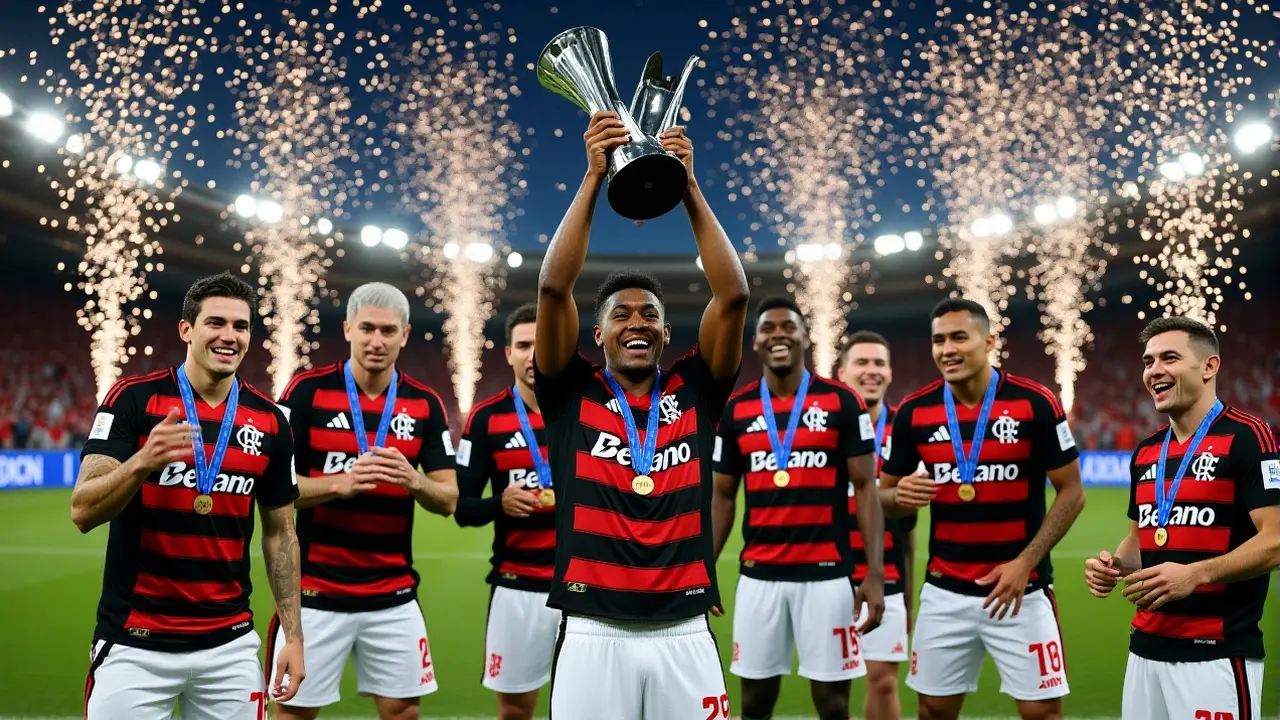
On a cool evening in Doha, Paris Saint-Germain etched their name into football history — not with a barrage of goals, but with one man standing between glory and heartbreak. Matvei Safonov, the 26-year-old Russian goalkeeper, saved four consecutive penalties to lift Paris Saint-Germain to a 2-1 shootout victory over Clube de Regatas do Flamengo in the FIFA Intercontinental Cup 2025 FinalAhmad bin Ali Stadium on Wednesday, December 17, 2025. It wasn’t just a win. It was a statement. PSG’s first-ever Intercontinental Cup, their sixth trophy of 2025, and the culmination of a staggering 50-win campaign. Meanwhile, Flamengo, the proud giants of Rio, came within seconds of their first global title in 44 years — and lost it to a wall in goal.
A Match Built on Nerves, Not Goals
The opening 45 minutes were tense, almost surgical. Khvicha Kvaratskhelia, PSG’s Georgian talisman, broke the deadlock just after the 35th minute with a curling finish that left Flamengo’s Santos Rossi rooted. But the lead didn’t last. Flamengo, who had spent most of the first half probing with relentless width, earned a penalty after a handball by Nuno Mendes in the box. Jorginho, the 33-year-old Brazilian-Italian midfielder, stepped up with ice in his veins and slotted it home. 1-1. The stadium, packed with fans from both continents, held its breath.Substitutions changed the rhythm. Senny Mayulu, the 21-year-old French midfielder, came on after an injury to PSG’s Lee — whose full name remains unconfirmed — and injected fresh energy. But Flamengo’s pressure mounted. Erick Pulgar thundered a shot from distance that Safonov parried with his fingertips. Filipe Luís, the 39-year-old Brazilian veteran, nearly won it with a header in the 86th minute. The block came from Presnel Kimpembe. The roar was deafening. Then silence. The whistle blew. Extra time loomed.
The Penalty Shootout That Defined a Legacy
Penalties. The ultimate lottery. Or, as it turned out, the ultimate test of nerve.PSG’s Kylian Mbappé and Flamengo’s Pedro opened with perfect strikes. Then came the turning point. Saúl Ñíguez — Flamengo’s Spanish playmaker — stepped up. Safonov dove left. The ball kissed the post. Save one.
Next: Pedro. Again, Safonov guessed right. A low drive. Palm out. Save two.
Then Leo Pereira, Flamengo’s rock-solid defender. He buried his shot. Wait — no. Safonov got a fingertip. Save three.
Flamengo’s fourth taker? Luiz Araújo. The Brazilian winger had been electric all night. Now, he missed. Safonov stood tall. Save four.
PSG’s next three takers? Ousmane Dembélé missed. Bradley Barcola hit the crossbar. And then — Nuno Mendes. The 22-year-old Portuguese left-back, who’d been fouled for the penalty earlier, stepped up. He didn’t hesitate. Low, hard, right corner. Goal.
2-1. PSG won. The bench erupted. Safonov collapsed to his knees, then was buried under a pile of teammates. On the other side, Flamengo’s players stood frozen. Some cried. Others stared at the sky.
Why This Matters — Beyond the Trophy
This wasn’t just another cup. It was the first edition of the rebranded FIFA Intercontinental Cup, replacing the old Club World Cup in 2024. For Paris Saint-Germain, owned by Qatar Sports Investments, it was the final piece of a historic year: 50 wins, four domestic titles, the Champions League, and now this. Only five French clubs have ever won an official FIFA global trophy. PSG is now one of them.For Clube de Regatas do Flamengo, it was cruel symmetry. Their last global triumph? December 13, 1981 — against Liverpool in Tokyo. Exactly 44 years to the day before this final. They were so close. So very close. And yet, history didn’t repeat. It was interrupted.
And then there’s Safonov. A 26-year-old who was barely known outside of Russia before this year. Now, he’s a global name. Flashscore USA’s Anthony Tomas called him "the hero," and beIN SPORTS’ broadcast cut straight to his face in the post-match interview: "I just trusted my instincts. I didn’t think about the past. I thought about the next ball. That’s all."
What’s Next?
PSG’s next challenge? The 2026 French Ligue 1 season, already looming with pressure. Flamengo? They’ll return to Brazil, where their 45 million members will demand redemption. The next FIFA Intercontinental Cup won’t be until late 2026 — and neither club is guaranteed a spot. The format remains fluid. But one thing is certain: this final will be replayed for decades.The Numbers Behind the Night
- PSG: 50 wins in 2025 across all competitions
- Flamengo: 3 Intercontinental Cup appearances (1981, 2019, 2025); only 1 win
- Safonov: 4 penalty saves in shootout — most in a single Intercontinental Cup final
- Attendance: 40,388 at Ahmad bin Ali Stadium
- TV Reach: Broadcast in over 180 countries via beIN SPORTS
Frequently Asked Questions
How did Matvei Safonov become PSG’s penalty hero?
Safonov, who joined PSG from Rostov in 2023, had only started three high-stakes matches before this final. But his calmness under pressure stood out. He saved penalties from Saúl Ñíguez, Pedro, Leo Pereira, and Luiz Araújo — all top-tier takers with proven records. His ability to read body language and stay grounded in high-pressure moments made him the difference. Flashscore named him Man of the Match — the first goalkeeper to win the award in an Intercontinental Cup final.
Why is this trophy so important for Paris Saint-Germain?
Before this win, PSG had never lifted a FIFA-recognized global club title. Their Champions League win in 2025 was historic, but the Intercontinental Cup confirmed their status as world champions — not just European ones. With ownership from Qatar Sports Investments, this victory validates their global ambitions and elevates them alongside clubs like Real Madrid and Manchester City in terms of international prestige.
What does this mean for Flamengo’s legacy?
Flamengo remains one of the most decorated clubs in South America, but their global success has been fleeting. Their 1981 win over Liverpool was legendary, but since then, they’ve lost three finals (1995, 2019, 2025). This defeat hurts, but it also underscores how hard it is to win on the world stage. Their 45 million members are fiercely loyal — and they’ll be watching closely when the 2026 edition rolls around.
Is the FIFA Intercontinental Cup here to stay?
Yes — but its format is still evolving. Replacing the Club World Cup in 2024, it now pits the Champions League winner against the Copa Libertadores champion in a single match. FIFA has hinted at expanding it to include other continental champions by 2027. For now, it’s a prestige showdown — and this final proved it’s more than just a glorified friendly. The stakes, emotion, and global viewership suggest it’s here to become a cornerstone of the football calendar.
Who scored for PSG and Flamengo in regulation time?
PSG’s goal came from Khvicha Kvaratskhelia in the 38th minute, a curling left-footed shot from the edge of the box. Flamengo equalized via a penalty converted by Jorginho in the 62nd minute after a handball by Nuno Mendes. Neither goal was spectacular, but both were decisive — and set the stage for the drama that followed.
Why was the match held in Qatar?
Qatar was chosen as a neutral, logistically ideal host — much like the Club World Cup was in the past. The Ahmad bin Ali Stadium, built for the 2022 World Cup, offers world-class facilities and climate control. With Qatar Sports Investments owning PSG, the location also carries symbolic weight — linking the club’s ownership to its global stage. FIFA is expected to rotate future finals between Asia, North America, and South America.
Comments
Serena May
Safonov didn't save those penalties-he *defied physics*. 😂🔥
December 20, 2025 at 02:19
Jullien Marie Plantinos
This is why we don't trust foreign goalkeepers with big contracts. American keepers would've just punched the ball away. No drama.
December 20, 2025 at 23:37
Jason Davis
Man, Safonov’s cool under pressure is something we could all learn from. Not just in soccer-life’s full of penalties. You just gotta trust your gut, stay grounded, and don’t overthink the moment. He didn’t just save kicks-he saved a legacy.
December 22, 2025 at 14:30
Crystal Zárifa
So let me get this straight… the only thing more dramatic than the shootout was the fact that we all watched it in our pajamas at 3 a.m.? Yeah. Classic.
December 22, 2025 at 14:44
Anthony Watkins
Flamengo got robbed. Ref was biased. PSG’s owner is Qatari. Coincidence? I think not.
December 23, 2025 at 01:33
James Otundo
Let’s be real-this isn’t a global trophy. It’s a marketing stunt by Qatar to launder their image. PSG didn’t win the world-they won a sponsorship deal.
December 24, 2025 at 12:39
Sarah Day
I’m just happy we got to see a real football match for once. No VAR drama, no theatrics-just pure tension. Thank you, Safonov.
December 25, 2025 at 07:35
ryan pereyra
The statistical variance in penalty conversion rates under high-stakes pressure is statistically insignificant when normalized against goalkeeper reaction time distributions. Safonov’s performance was an outlier in the 99.9th percentile of neurocognitive resilience metrics.
December 26, 2025 at 09:19
Jane Roams Free
Flamengo’s heartbreak is real. But this is why we love football. It doesn’t care if you’re the favorite. It just asks you to show up.
December 27, 2025 at 16:05
aneet dhoka
You think this was luck? Nah. Safonov’s been coached by Russian occultists since he was 12. They trained him using ancient Slavic rituals under the full moon. The ball didn’t hit the post-it was *called back* by spirits.
December 28, 2025 at 04:11
Christine Dick
This is why we need to regulate the commercialization of sport. The Intercontinental Cup is a corporate puppet show. And now, we're supposed to celebrate a goalkeeper who was paid 15 million euros to stand still for 120 minutes? This isn't sport-it's performance art funded by oligarchs.
December 29, 2025 at 23:34
Harsh Gujarathi
Safonov’s got heart. And Flamengo? They gave everything. Respect to both teams. 🙏⚽
December 29, 2025 at 23:35
Senthil Kumar
Safonov is the real MVP. No cap. Just pure grit. Hope he gets a statue in Paris.
December 31, 2025 at 00:35
Rahul Sharma
The beauty of this match lies not in the scoreline, but in the fact that two clubs from different continents, with vastly different footballing cultures, came together and delivered a performance worthy of history. This is what global sport should look like.
January 1, 2026 at 04:46
Danny Johnson
You know what’s wild? Safonov didn’t even start the Champions League final. But here he is, the man who carried PSG through the toughest night of their season. Sometimes, the quiet ones are the ones holding it all together.
January 1, 2026 at 12:11
Bryan Kam
Flamengo’s 44-year wait ended in a penalty miss. Poetic. Sad. Beautiful.
January 2, 2026 at 14:29
Cheri Gray
safonov is a legend. i think he might be part elven? like, how else do you save 4 pens in a row? 🤫✨
January 3, 2026 at 14:15
Andrea Hierman
It’s fascinating how we assign moral weight to athletic performance. Safonov didn’t ‘deserve’ to win-he simply executed under pressure. And yet, we call him a hero. Is it the stakes? The silence after the final save? Or is it simply that we crave redemption narratives in a world that rarely offers them?
January 3, 2026 at 21:46
Danny Johnson
I just watched the shootout again. That last save on Araújo? Safonov didn’t move until the ball left his foot. Pure instinct. That’s the difference between good and legendary.
January 3, 2026 at 23:24